
This is a documentation guide for nursing students and new nurses, not medical or clinical advice. Every unit does things a little differently, so your facility’s policies, the provider’s orders, and your preceptor always come first.
A telemetry floor has its own kind of noise. Every patient is wearing a set of electrodes that feeds a rhythm strip to a monitor at the station, and that strip updates every second. Vital signs can shift faster than they do on a general medical floor, and a nurse carrying four to six of these patients is keeping track of alarms, cardiac drips, and small lab changes all at the same time.
That’s why a report sheet built for a general med-surg floor tends to fall short here. It has room for the diagnosis and the diet order, but nowhere obvious to put a baseline rhythm or a heparin rate. A telemetry sheet is really just a med-surg sheet with the heart given its own space, and once you know what belongs in that space, shift report gets a lot easier to follow.
What goes at the top
The top of the sheet holds the things you need to find in a hurry. Room, name, age, provider, and admitting diagnosis come first, followed by code status, which you never want to be hunting for during an emergency.
Fall risk deserves a line of its own on this kind of unit. Many cardiac patients take blood pressure medications and diuretics, and a patient who feels fine in bed can get lightheaded the moment they stand up. Allergies belong here too, and on a cardiac floor it’s worth noting specifically whether there is any history of reactions to contrast dye or to heparin, since both come up often.
The rhythm box
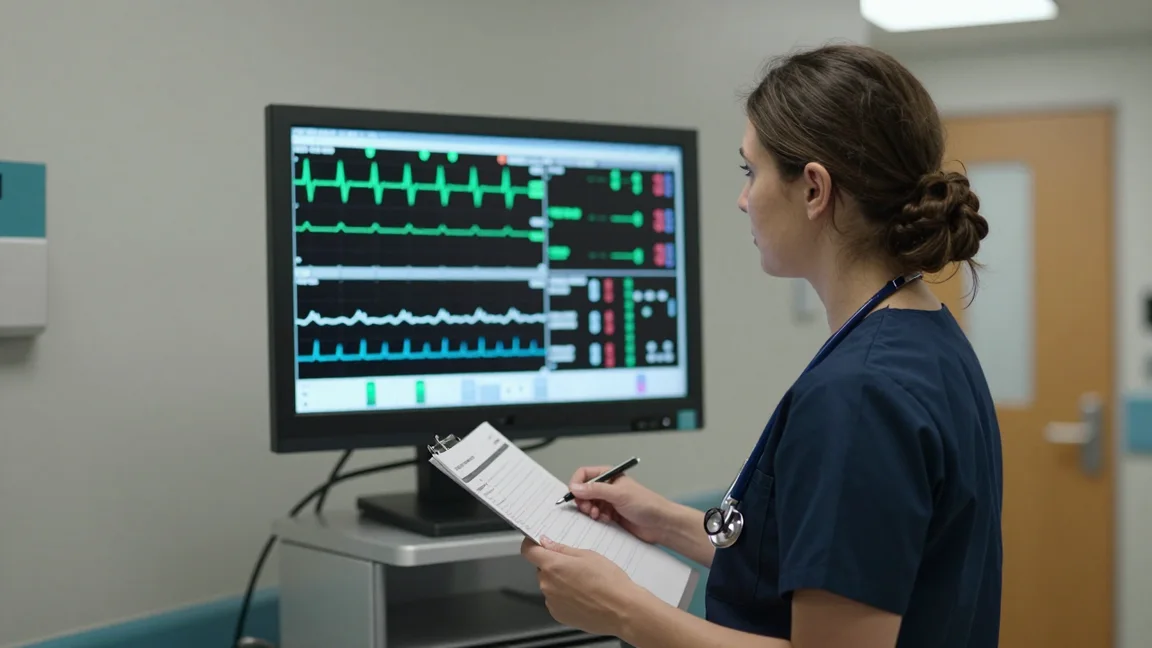
This is the section that makes a telemetry sheet different from every other report sheet. Most nurses keep one line for the patient’s baseline rhythm — normal sinus, sinus bradycardia or tachycardia, atrial fibrillation, atrial flutter, or a paced rhythm — and a second line for anything unusual seen during the shift, such as frequent PVCs or a short run of a fast rhythm, along with roughly when it happened and how long it lasted.
If the patient has a pacemaker or an implanted defibrillator, that goes here as well, with whatever settings are documented in the chart. It also helps to jot down the condition of the electrode sites and when the patches were last changed. That sounds like a small detail, but a loose or dried-out electrode is one of the most common reasons a monitor alarms for no real reason.
Vital sign targets and oxygen
Cardiac patients often have blood pressure and heart rate goals written specifically for them, and those goals differ from one patient to the next. Writing the ordered range in plain numbers on the sheet means you aren’t trying to remember, at three in the morning, which of your patients is supposed to stay under a certain systolic pressure.
Oxygen needs sit alongside: how much the patient is on, by what device, and whether their saturation tends to dip when they sleep.
Labs that matter more here
On a telemetry floor, small changes in electrolytes get more attention than they would elsewhere, because potassium and magnesium levels affect how stable the heart’s rhythm is. Many nurses give those two values their own box on the sheet. Cardiac units often aim to keep them toward the higher end of the normal range, but the exact targets and any replacement doses come from the provider’s orders or the unit’s protocol, not from the sheet.
The other values worth a line are the troponin trend (is it rising, has it peaked, is it coming down), kidney function, which matters for diuretics and for clearing contrast dye, and clotting labs for anyone on a blood thinner.
Drips, lines, and fluid balance
Continuous cardiac infusions each get their own line on the sheet: the drug, the current rate, the most recent lab it is being adjusted against, and when the next lab is due. Heparin is the classic example, but medications for rate and rhythm control and for chest pain show up here too.
Because many of these patients are being treated for fluid overload, intake and output is more than a formality. A fluid restriction, the response to a dose of diuretic, and a daily weight tell the next nurse whether the plan is working. IV access rounds out the section — where the line is, what kind it is, and whether it’s still running well.
Tests and timed tasks
Telemetry patients tend to be on their way to something: an echocardiogram, a stress test, a trip to the cath lab. Each of those comes with timing attached, such as when the patient has to stop eating, or a repeat lab that is due at a set interval. A running task line with the times written next to it keeps those from slipping during a busy stretch.
A one-minute handoff
Reciting a patient’s entire history at shift change wears out the nurse who is listening. A tighter report, built on SBAR and focused on what changed, is easier to take in. Here is what that can sound like for a made-up patient:
S: “Room 304, Mr. Henderson, 71, admitted yesterday with a heart failure exacerbation and shortness of breath. Full code.”
B: “History of diabetes and atrial fibrillation, two coronary stents three years ago. On admission he had crackles at both lung bases and swelling in both legs.”
A: “Rhythm has been controlled A-fib, rate in the 70s and 80s. He had IV Lasix this morning with good urine output. Sats are 96% on 2 liters. Potassium came back a little low and was replaced by mouth per the order.”
R: “Echo is scheduled for 2 PM. A repeat potassium is ordered for 4 PM — please follow up on that, and keep an eye on whether the diuresis continues.”
Notice that it follows the same order as the sheet. When the sheet is filled in as the shift goes on, the report is mostly a matter of reading down the page.

What tends to go wrong
Not knowing the baseline. When an alarm goes off, the first question is whether this rhythm is new for this patient. Nurses who look at each patient’s strip early in the shift and note it on the sheet can answer that in seconds. Without a baseline, every alarm is a guess.
Chasing alarms that are really electrodes. A large share of nuisance alarms come from patches that have dried out or lifted. Checking the sites on the first round saves a lot of interruptions later.
Giving a heart medication without checking the hold parameters. Many rate and blood pressure medications are ordered with instructions to hold the dose if the heart rate or blood pressure is below a certain number. Those numbers vary by order and by facility, so the habit that matters is checking the vital signs against the actual order every time, and letting the provider know when a dose is held.
Treating a drip change as a one-person job. High-alert infusions like heparin are usually governed by strict policies — often a second nurse verifying a rate change or a new bag, and specific rules about what can share a line. New nurses are expected to know their own unit’s version of those rules and to ask rather than assume.
Getting caught empty-handed on rounds. Cardiology teams tend to ask the same few things: urine output overnight, this morning’s kidney function and potassium, and whether there was any chest pain. Having those in one corner of the sheet means answering without digging through the chart.
Sources
- AHRQ – patient handoff and SBAR communication resources
- NCBI Bookshelf – cardiac monitoring and telemetry nursing overview
- General nursing education references on report-sheet documentation
Disclaimer: This article is a documentation guide for nursing students and new nurses, for general informational purposes only. It is not medical, clinical, or exam advice, and is not affiliated with or endorsed by the NCLEX® or NCSBN®. Always follow your facility’s policies and your preceptor’s guidance.