Tag: nurse brain sheet

  • How to Use a Med-Surg Brain Sheet

    How to Use a Med-Surg Brain Sheet

    How to Use a Med-Surg Brain Sheet (A Beginner’s Guide)

    As an Amazon Associate I earn from qualifying purchases. This is a documentation guide for nursing students and new nurses, not medical or clinical advice. Every unit does things a little differently, so your facility’s policies and your preceptor always come first.

    Med-surg is where most new nurses start, and it is also where the brain sheet earns its keep. You are not watching one patient closely – you are keeping four, five, sometimes six of them straight at once, all shift, while call lights and phone calls interrupt you. Most nurses on these floors settle into some version of a one-page-per-shift sheet. Here is how they tend to use it.

    What makes a med-surg sheet different

    An ICU sheet goes deep on one patient. An ER sheet is built for turnover. A med-surg sheet has to do something harder: hold several patients at a readable glance. That is why most of them are laid out in blocks – three or so patients to a page – rather than one patient spread across a full sheet. The trade-off is space. You get less room per patient, so what you write has to be chosen more carefully.

    That constraint turns out to be the useful part. When there is room for everything, people write everything, and a sheet with everything on it is a sheet nobody can read at a glance. A block that holds eight lines forces a decision about which eight things matter for this patient today, and making that decision is most of what experienced nurses are doing when they look like they are just writing.

    It is worth saying what the sheet is not. It is a working copy for your own shift, not the chart and not a legal record. Permanent documentation happens where your facility says it does. Most units also treat the sheet as protected information while it exists – in a pocket rather than on a counter, shredded at the end of the shift rather than carried home – and that policy is worth asking about on day one.

    The header block, and why people fill it first

    The top of each patient block usually carries the room number, name, age, admitting diagnosis, code status, and allergies. Nurses tend to fill this in during report and then leave it alone. It is the part you will glance at when a provider calls and asks about “the patient in 412” – and glancing is much easier than remembering.

    Isolation status is worth a spot here too. Contact, droplet, airborne – whatever applies. It saves a walk back to the supply cart.

    A few other entries earn header space on most med-surg sheets. Mobility and fall risk, because they change how you enter the room. Diet and whether the patient is NPO, because it is the question you get asked most by patients and families. And the anticipated discharge date, which sounds like case management’s business until the morning it is today and nothing has been arranged.

    None of this takes long. Filling the header during report is maybe a minute per patient, and it is the minute people are gladdest about at two in the afternoon when a provider calls about the patient in 412.

    Writing down what actually changes

    Below the header, most sheets give a few lines per patient for the moving parts: IV site and what is running, oxygen and how much, diet, activity level, and any drains or tubes. On med-surg these do not change minute to minute the way they do in an ICU, but they change often enough that yesterday’s notes will mislead you.

    A habit that seems to help: write in something you can update, and cross out rather than erase. If a patient came off oxygen at ten in the morning, the crossed-out “2L NC” beside the new note is a small piece of history you may be glad to have at handoff.

    Med-surg has a particular version of this problem. Because the patients are more stable than in critical care, it is easy to write the picture once in the morning and treat it as settled. The changes that matter here are often slow ones – a wound that looks slightly worse, someone eating less than yesterday, a patient who was walking to the bathroom and now is not. None of those announce themselves. All of them are visible in a sheet that gets updated and invisible in one that does not.

    Time management, which is what the sheet is really for

    Ask a med-surg nurse what the hardest part of the job is and very few will say clinical knowledge. Most will say the clock.

    You have several patients, a medication pass that has to happen within a window, providers rounding at unpredictable times, a discharge that needs teaching, an admission that could arrive at any moment, and a phone that does not stop. Nobody organizes that in their head.

    The way most people handle it is to give the sheet a time column – a rough map of the shift with the fixed points marked. Medication times, scheduled treatments, anything with a window. What is left between those fixed points is the space where everything else has to fit, and seeing that space honestly is what stops the day from turning into a series of surprises.

    The related habit is writing down interruptions instead of trying to hold them. Someone stops you in the hallway to ask for a warm blanket while you are on your way to hang an antibiotic. Written on the sheet, it happens in ten minutes. Held in your head, it competes with the antibiotic and one of them loses.

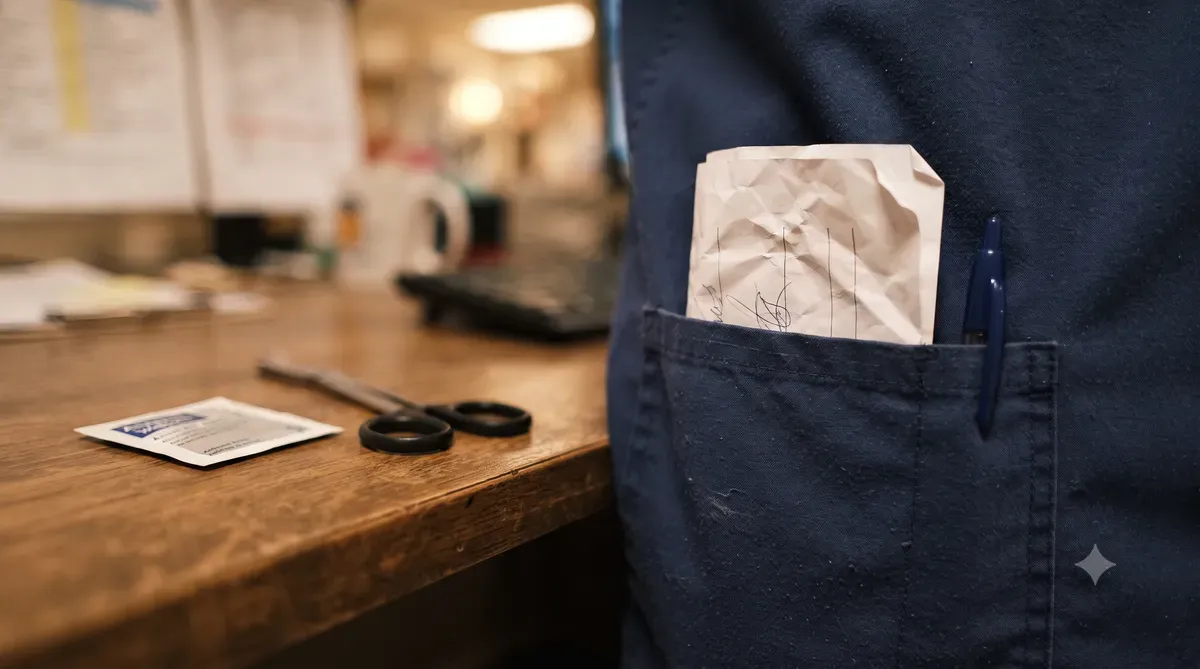
    Folded nurse report sheet on a desk beside a pen and bandage scissors

    Report sheet folded beside a pen and scissors

    The to-do column is the part that saves your shift

    If there is one section experienced med-surg nurses guard, it is the running task list. Dressing change at fourteen hundred. Blood sugar before dinner. Discharge teaching for 410. Ambulate 408 twice.

    The reason this column matters more here than on other units is interruption. You will be pulled away mid-task more times than you can count, and the sheet is what tells you where you were. Nurses who cross items off as they finish tend to describe the same benefit: their eye lands on what is left, not on what is done.

    Most people end up using two marks rather than one – something for done and something else for waiting on someone. The difference matters. A dressing change you have not done yet is a task. A consult you called an hour ago is not a task, it is a thing that will fall through if you stop looking at it, and it needs to stay visible in a way that completed items do not.

    Discharges deserve their own small list. Prescriptions, instructions reviewed, follow-up appointment, transportation, equipment ordered. None of it is difficult and all of it is easy to lose when three other things are happening at once.

    Times, not just numbers

    Vital signs, blood sugars, pain scores, PRN medications – most sheets have somewhere to note these, and the entry that gets skipped under pressure is the time. It is also the entry that makes the rest useful. A pain score of 7 means one thing an hour after morphine and something else four hours after. The same goes for the last time a PRN was given, which is usually the first question the next nurse asks.

    Reassessment after a PRN is the one people most often mean to do and most often forget in the moment. Writing the time you gave it, with a small mark for the recheck, is the difference between remembering and hoping you remember. It also answers the question that comes up in any chart review – whether the response was reassessed – without anyone reconstructing the afternoon.

    Blood sugars have their own rhythm on med-surg, tied to meals rather than to the clock, and a sheet that records the value, the time, and what was given for it turns three scattered numbers into something you can actually talk about in report.

    Getting ready for handoff while the shift is still going

    The nurses who give calm report are usually not the ones with better memories. They are the ones whose sheet was already close to a report by the time report came. If you jot the one-line version of what changed as it happens – “started on IV abx at 1000, tolerating,” “refused PT, will retry PM” – handoff turns into reading rather than reconstructing.

    SBAR is the usual frame for saying it out loud: situation, background, assessment, recommendation. A sheet kept current already holds those pieces in the order you will need them.

    The recommendation is the part new nurses leave off, usually because it feels like overstepping. Within scope, it is not. You are not diagnosing – you are saying what you think should happen next, and after twelve hours you are the person best placed to say it.

    What tends to go wrong

    A few patterns come up often enough to name.

    Writing too much. Trying to transcribe the chart produces a sheet too dense to read at a glance, which was the whole point.

    Writing only in the morning. A sheet that reflects the patient as they were at eight is worse than no sheet at four, because it looks current.

    Trusting memory for the busy patient. The patient taking all your attention is the one you are most certain you will remember and most likely to be asked about later.

    Redesigning it weekly. People who keep changing the layout never build the muscle memory that makes the layout invisible.

    Leaving it somewhere. A brain sheet is a document with patient information on it. Where it goes at the end of the shift is a policy question, not a preference.

    Give it a few weeks

    The first month, most people’s sheets are a mess of arrows and margin notes, and they run out of room by noon. That is normal. Nurses who keep the same layout every shift rather than redesigning it weekly usually find that their hand starts going to the right box on its own, which is the point – the sheet is supposed to take less attention, not more.

    Most people develop shorthand within a couple of months. An arrow for a trend heading the wrong way. A circle around anything to mention in report. A corner reserved for the two things the oncoming nurse must not miss. None of it is standardized and none of it needs to be, with one exception: anything another nurse might need in a hurry if you are pulled into a room should stay legible to someone else. Allergies, code status, isolation. Your personal shorthand is fine everywhere else.

    If drawing your own boxes every morning is the part you would rather skip, that is what a pre-printed brain sheet notebook is for.

    BY ELDER K · ON AMAZON
    Med-Surg Nurse Brain Sheet Notebook cover
    Med-Surg brain sheet interior page
    Med-Surg Nurse Brain Sheet Notebook
    See the cover and what’s inside — 110 brain sheets laid out for three patients per page – the usual med-surg load. 8.5×11.

    View on Amazon →

    Nurse Clipboard with Storage

    Nurse Clipboard with Storage

    See the design and price on Amazon →

    Sources

    AHRQ – patient handoff and SBAR communication resources

    NCBI Bookshelf – nursing handoff and shift report overview

    General nursing education references on report-sheet documentation

    Disclaimer: This article is a documentation guide for nursing students and new nurses, for general informational purposes only. It is not medical, clinical, or exam advice, and is not affiliated with or endorsed by the NCLEX® or NCSBN®. Always follow your facility’s policies and your instructors’ guidance.

  • How to Fill Out an ICU Brain Sheet

    How to Fill Out an ICU Brain Sheet

    As an Amazon Associate I earn from qualifying purchases. This is a documentation guide for nursing students and new nurses, not medical or clinical advice. Every unit does things a little differently, so your facility’s policies and your preceptor always come first.

    If you are looking at a blank ICU brain sheet with no idea where to start, that is where nearly everyone starts. A brain sheet – some units call it a report sheet, or just a nurse brain – is a one-page map of what is happening with your patient, kept where you can see it instead of in the chart. Here is what ICU nurses tend to put on theirs, box by box.

    What the sheet is actually for

    Most nurses describe it as external memory. Over twelve hours you are tracking vitals, drips, labs, lines, and a running list of small tasks, and holding all of that in your head is not a skill anyone develops – it is just a thing people stop trying to do.

    A sheet that is working lets you glance down and answer the two questions you get asked most: what is going on with this patient, and what still needs doing.

    It is worth being clear about what the sheet is not. It is not the chart, and it is not a legal record. Whatever goes on it is a working copy for your own shift, and the permanent documentation still happens where your facility says it happens. Most units also treat the sheet as protected information for as long as it exists – kept in a pocket rather than on a counter, and shredded at the end of the shift rather than carried home. Every hospital has a policy on this, and it is one of the first things worth asking about on a new unit.

    The other thing a sheet quietly does is protect you from the middle of the night. At three in the morning, after eleven hours, recall gets unreliable in ways that feel fine from the inside. Nurses who have been doing this a while tend to trust their handwriting from four hours ago more than their memory of four hours ago, and that instinct is usually right.

    The header, and why people fill it first

    The top bar is the part that gets rushed and later regretted. Date, shift, your name, room number, and code status. Allergies and admitting diagnosis usually sit here too.

    Code status tends to be placed in the first line of sight rather than tucked in with the demographics, and the reason is simple enough: it is the one thing nobody wants to be looking up in a hurry. New nurses often put it in the middle of the block, and experienced ones almost always move it to the top.

    Isolation status usually earns a place up here too. Contact, droplet, airborne, or none – written where you will see it before you walk in rather than after. The same goes for anything that changes how you approach the room at all: a patient on fall precautions, a language other than the one you speak, a hearing aid that is out.

    Weight is another entry that looks like a formality until it is not. Many ICU drips are ordered per kilogram, and a weight recorded once at the top, in kilograms, is what keeps the rest of the sheet consistent with the pumps.

    None of this takes long. The header is maybe thirty seconds of writing during report, and it is the thirty seconds people are gladdest about later.

    A head-to-toe pass, in the same order every time

    Below the header, most ICU sheets leave space for a systems review. The order matters less than the fact that it does not change:

    • Neuro – alert level, sedation, pupils, any deficits.
    • Cardiac – rhythm, blood pressure, which drips are running.
    • Respiratory – room air, nasal cannula, or vent settings.
    • GI/GU – diet or tube feeds, last bowel movement, urine output.
    • Skin and lines – wounds, dressings, and every line and drain.

    Nurses who use the same sequence every shift usually find that after a few weeks their hand goes to the next box on its own. That is the point of the consistency – it is what keeps the small items from being the ones that get skipped.

    The systems that get skipped most, when something gets skipped, are usually skin and GI. Neither tends to be the reason the patient is in the unit, so both slide down the list on a busy day. Both are also where problems build slowly and then show up all at once, which is exactly the pattern a written record catches and memory does not.

    There is a second use for this section that new nurses discover a few months in. Because you wrote the same categories at the start of the shift, you have a baseline to compare against at hour eight. “Pupils were equal at seven” is a much stronger statement than “I think they looked normal earlier,” and the only difference between the two is that one was written down.

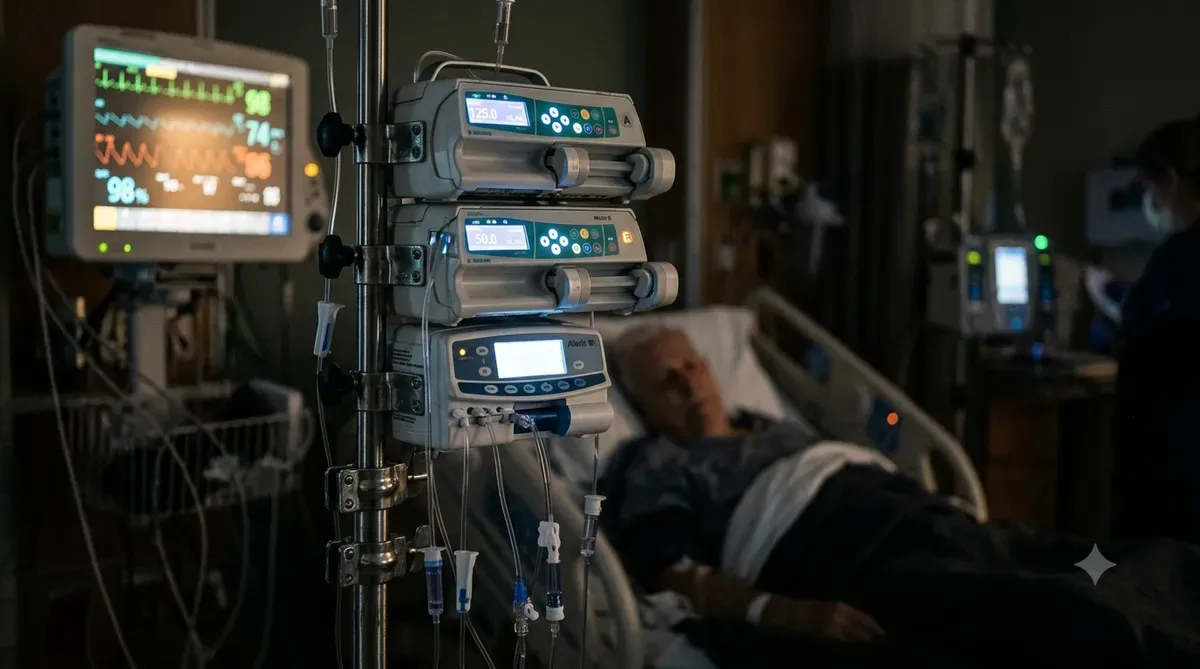
    IV infusion pumps beside a hospital bed with a patient monitor in the background

    IV pumps and monitor at the bedside

    Vitals read better as trends

    There is usually a small grid for vital signs, and the common beginner habit is to write one number and move on.

    In critical care the direction tends to carry more information than the value. A blood pressure of 95 reads one way if it was 130 an hour ago and another way if it has been climbing from 80. Sheets with room for the last two or three readings make that visible without anyone having to reconstruct it, and that shape is often the first hint that something is changing.

    The monitor already holds all of this, which makes writing it down feel redundant on a quiet shift. The reason nurses do it anyway is that the monitor shows you a moment and the sheet shows you a shape. Scrolling back through trend data while a provider waits on the phone is a slower and more error-prone way to answer the same question.

    Intake and output belongs in the same category. On its own, an hourly urine output is a number. Across a shift it is a trend, and it is often the trend that gets quoted back to you in rounds. Nurses who total it as they go rather than at the end tend to find the totals are both faster to produce and closer to correct.

    Drips and lines do better with their own space

    ICU patients often have several drips running, and this is where a cramped sheet stops helping. The layout most nurses prefer gives each drip its own line – the medication, the current rate, and any titration goal in the orders. Lines and drains get the same treatment: where each one is and when it was placed.

    Titration goals deserve their own mention. When an order allows a range, what matters is not just the current rate but what you are titrating toward – a MAP, a sedation score, a target the provider set. Sheets that record the goal beside the rate save the conversation where two people discover halfway through the shift that they were aiming at different numbers.

    Line day counts are another small entry with an outsized payoff. Writing the date a central line or a Foley went in means that when someone asks whether it is time to reassess, the answer is on the page instead of buried in the chart.

    Worth stating plainly: the sheet records what is ordered and what is running. It is not a place to work out doses, and nothing written on it replaces the orders, your facility’s protocols, or independent verification. Any dose that comes off a sheet still gets checked against the order and, where policy requires it, with a second nurse.

    The SBAR box

    The bottom of most brain sheets leaves room for SBAR – Situation, Background, Assessment, Recommendation. It is the frame used for shift report and for calling a provider.

    Nurses who jot a few words into each part through the shift tend to describe handoff the same way: by the time report comes, it is mostly already written. The alternative is reconstructing twelve hours from memory while someone waits.

    The recommendation is the part new nurses most often leave off, usually out of a sense that it is not their call. Within scope, it is. You are not diagnosing – you are saying what you think should happen next, and you are the one who has been in the room for twelve hours. “I think she needs to be seen before morning” is a clinical impression, and it is frequently the most useful sentence in the handoff.

    What tends to go wrong with a brain sheet

    A few failure patterns come up often enough to be worth naming.

    Writing too much. New nurses often try to transcribe the chart, which produces a sheet too dense to read at a glance – which was the entire point. The sheet is a map, not a copy.

    Writing too little. The opposite failure is a sheet with three words on it that made sense at eight in the morning and mean nothing at six at night.

    Not updating it. A sheet that reflects the patient as they were at the start of report is worse than no sheet, because it looks current. Crossing out and rewriting takes seconds.

    Redesigning it every week. People who keep changing their layout never build the muscle memory that makes the layout invisible. Most experienced nurses use something close to what they used a year ago.

    Where people land, eventually, is a version they stop thinking about. That is the goal – not a beautiful sheet, an automatic one.

    A rough order that works for the first hour

    There is no correct sequence, but a common one looks like this. During report, fill the header and note anything flagged as changing. Right after report, do a quick eyes-on round of every patient before touching the paperwork again. Then go back and fill in what you actually saw rather than what you were told.

    The gap between those two is where new nurses learn the most. Report is someone else’s summary; the round is yours. When they disagree, that disagreement is usually worth a second look, and it is much easier to notice when both versions are written down.

    Making it yours

    Most nurses develop shorthand within a couple of months – arrows for trends, a symbol for tasks that are pending versus done, a corner reserved for numbers to report in rounds. None of it is standardized and none of it needs to be, as long as the next person can read the parts that matter if you are pulled away.

    The one thing worth keeping legible is anything another nurse might need in a hurry: code status, allergies, drips and rates. Your personal shorthand is fine everywhere else.

    Small habits that seem to help

    Write in something you can update, because patients change and so should the sheet. Cross tasks off as they are done, so your eye lands on what is left. And do not aim for a tidy sheet – the useful one is usually the marked-up one that got someone through the shift.

    Keep the sheet in one place, ideally the same pocket every shift, so that finding it is never a step. Note the time on anything time-sensitive rather than trusting that you will remember the gap. And when the shift falls apart – and some do – the sheet is usually the first thing to abandon and the first thing worth picking back up as soon as there is a gap, because the twenty minutes you did not write are the twenty minutes you will be asked about.

    If drawing your own boxes every morning is the part you would rather skip, that is what a pre-printed report notebook is for – the header, systems, vitals grid, and SBAR box are already laid out.

    BY ELDER K · ON AMAZON
    ICU Nurse Report Sheet Notebook cover
    ICU brain sheet interior page
    ICU Nurse Report Sheet Notebook
    See the cover and what’s inside — 110 single-patient brain sheets with head-to-toe, a vitals grid, drips, and a dedicated SBAR box. 8.5×11.

    View on Amazon →

    Littmann Classic III Stethoscope

    Littmann Classic III Stethoscope

    See the design and price on Amazon →

    Sources

    • AHRQ – patient handoff and SBAR communication resources
    • NCBI Bookshelf – head-to-toe nursing assessment overview
    • General nursing education references on report-sheet documentation

    Disclaimer: This article is a documentation guide for nursing students and new nurses, for general informational purposes only. It is not medical, clinical, or exam advice, and is not affiliated with or endorsed by the NCLEX® or NCSBN®. Always follow your facility’s policies and your instructors’ guidance.