Category: Critical Care

  • SBAR Handoff for New Nurses

    SBAR Handoff for New Nurses

    SBAR Handoff for New Nurses (A Beginner’s Guide)

    As an Amazon Associate I earn from qualifying purchases. This is a documentation guide for nursing students and new nurses, not medical or clinical advice. Every unit does things a little differently, so your facility’s policies and your preceptor always come first.

    Giving report is the part of nursing that makes new nurses most self-conscious, and it is one of the few skills nobody really practices before doing it in front of an audience. SBAR is the frame most units use to keep it organized – Situation, Background, Assessment, Recommendation. Here is what each letter tends to hold, and why the order matters more than it looks.

    Why a frame helps at all

    Without a structure, report tends to come out in the order things happened to you rather than the order the listener needs. The receiving nurse does not need your morning; they need to know what they are walking into.

    SBAR fixes the order. That is most of what it does, and it is enough.

    It came out of aviation and the military before it came into healthcare, and the reason it transferred is that both fields have the same problem: someone with information has to hand it to someone who has none, quickly, often under pressure, and often across a difference in seniority that makes people hedge. A shared structure means the listener knows what is coming next, which is a surprisingly large part of being understood.

    It is also worth saying what SBAR is not. It is not a script you have to recite word for word, and it is not a substitute for your facility’s handoff policy or whatever tool your unit uses. It is a way of ordering what you were going to say anyway.

    S – Situation

    One or two sentences: who this is and why you are talking about them right now.

    Room, name, age, and the reason for admission, then the reason for this conversation. For shift report that is usually the state of the patient. For a provider call it is the thing that prompted the call, said in the first sentence rather than the fifth.

    New nurses often start too far back. The listener has not met this patient yet, but they also cannot hold a history before they know what the point is.

    A useful test: could the person you are calling write down why you called after your first two sentences? If not, the situation has not landed yet.

    For a call in the middle of the night, most experienced nurses front-load even harder. Name, room, and the problem in one breath, before anything else. The provider you woke up is orienting from zero, and the fastest way to help them is to say the thing you are worried about first.

    B – Background

    The context that makes the situation make sense. Admitting diagnosis, relevant history, allergies, code status, what has been done so far this admission.

    The judgment call here is what counts as relevant, and it takes a while to develop. The rough test most nurses use: would this change what the listener does next? A cardiac history matters for a patient with new chest pain. A childhood appendectomy usually does not.

    Background is also where the length of a handoff is usually decided, and where the difference between a shift report and a provider call is largest. A provider calling back at two in the morning wants three or four items. A nurse taking your patients for the next twelve hours wants considerably more, because they will be living with the details.

    New nurses tend to err toward completeness, and that instinct is not wrong at the start – it is easier to learn to trim than to learn to notice what you left out. Most people find the filter develops on its own within a few months, largely by watching which parts of their report people wrote down.
    Wall-mounted hospital telephone beside a notepad and pen

    Hospital phone with a notepad

    A – Assessment

    What you are seeing, and what you make of it.

    Vitals with trends rather than single values, your relevant findings, and pain. Then, and this is the part that feels presumptuous at first, your read on it. “I think she is more short of breath than this morning.” “Something seems off, but I cannot point to one number.”

    New nurses often leave this out, on the grounds that it is not their place to interpret. It is – within scope. You are not diagnosing. You are reporting a clinical impression, and it is often the most valuable sentence in the call, because you are the one who has been in the room.

    The phrasing that helps most people get past the hesitation is simple ownership: “what I am seeing is,” or “what worries me is.” Both are honest about the fact that this is your read, and neither claims more than that.

    It is also fine to say you cannot name it. “Nothing on the monitor has changed but she looks different to me” is a legitimate assessment statement, and experienced clinicians tend to take it seriously, because that particular sentence has a good track record.

    R – Recommendation

    What you are asking for, or what you think should happen next.

    For a provider call: “Could you come see her,” or “would you like an ABG.” For shift report: what is still pending, what is scheduled, and what to watch for.

    Ending without this is the most common way an otherwise good report falls flat. The listener has all the information and no idea what you want done with it.

    The other half of the recommendation is closing the loop. If an order comes back verbally, most units expect it read back and confirmed, and that read-back is part of the handoff rather than an add-on. If nothing is ordered and you are still uneasy, saying when you will call again – or asking what would change the plan – keeps the conversation from ending in an ambiguity you have to sit with for four hours.

    When it does not go smoothly

    Not every call goes well, and new nurses tend to assume that means they did it wrong.

    Sometimes the person on the other end is short with you. Sometimes they ask a question you cannot answer, which is worth writing down and looking up rather than guessing at. Sometimes you get a plan you do not agree with.

    Every facility has a chain of communication for that last one, and knowing what yours is – before you need it – is part of being ready to make these calls at all. Escalating is not a conflict; it is the process working. Your charge nurse is usually the first step and is almost always glad to be asked early rather than late.

    If a call goes badly, the useful move afterward is to write down what you would say differently. Most people’s reports improve in specific, fixable ways rather than gradually.

    Shift report is a different animal

    Provider calls are narrow and deep – one problem, one decision. Shift report is wide and shallow, and it has a different failure mode: running out of attention before running out of patients.

    Most nurses handle this by putting the same things in the same order every time and keeping the first pass short. Room, name, age, why they are here, code status, and the one thing that matters most for this patient. The details follow for the patients who need them.

    The other thing worth doing is naming what is unfinished plainly rather than burying it. “The two o’clock antibiotic did not get hung, it is still due” is a better sentence than a hopeful summary. Nobody minds being told; people mind finding out.

    Where the report sheet comes in

    The nurses who give calm report are usually not the ones with better recall. They are the ones whose sheet already had the pieces.

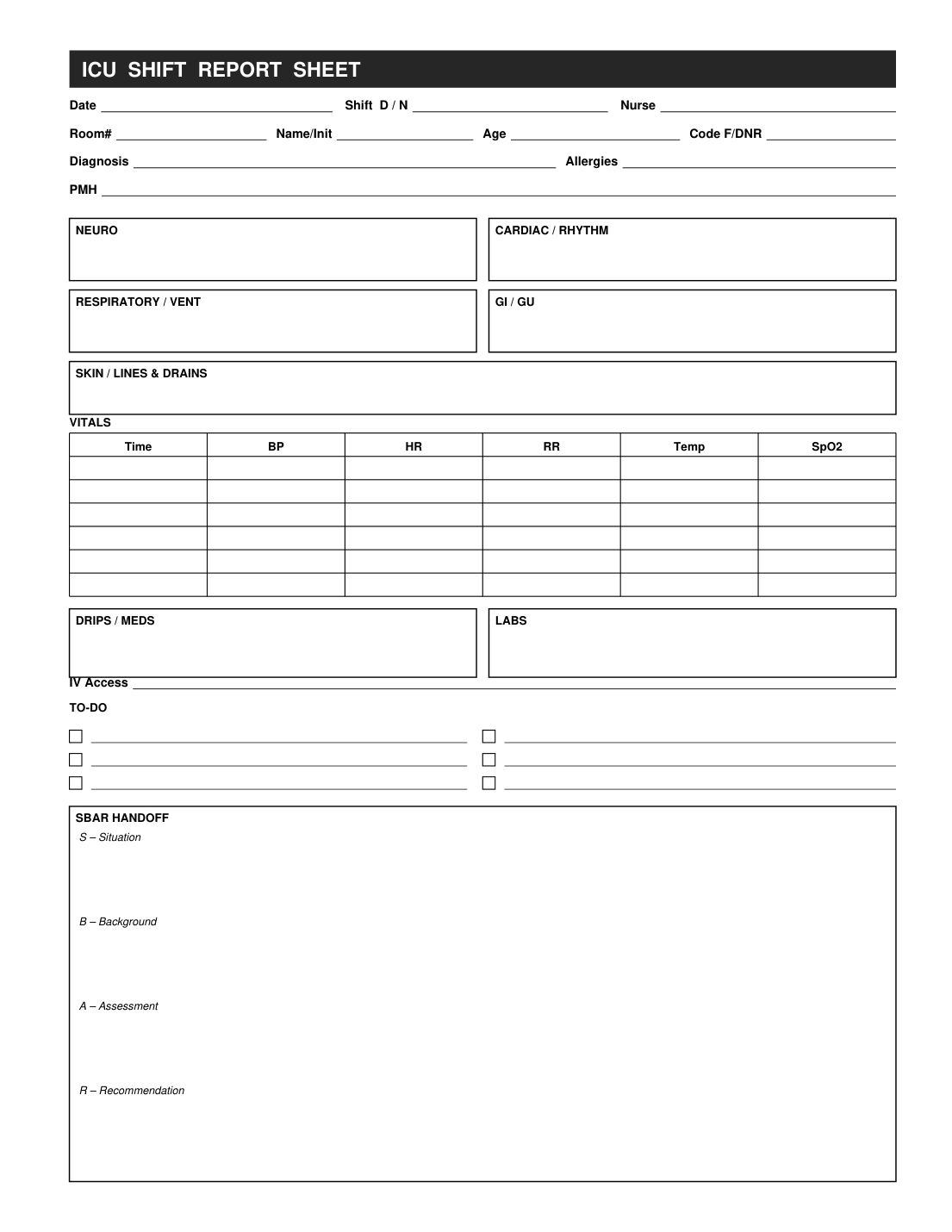
    A sheet kept current through the shift tends to map onto SBAR almost directly. The header block is your situation. History, allergies, and code status are your background. The vitals grid and your notes are your assessment. The to-do column and what is pending is your recommendation. Many report sheets include a dedicated SBAR box for exactly this reason – so that a few words jotted at the time become report later, rather than something you rebuild from memory at seven in the morning.

    It gets less uncomfortable

    Early on, report feels like a test. Later it feels like a conversation between two people who both want the same thing.

    What shortens that gap for most people is having the same structure every time and writing as they go. Neither is a talent. Both are habits.

    If it helps, the things new nurses are self-conscious about are rarely the things the listener notices. Speaking slowly is fine. Pausing to check your sheet is fine, and reads as thorough rather than unprepared. Saying “I do not know, let me find out” is fine and is a much better answer than a guess.

    What people do notice is a report that arrives in a random order, and that is the one part a structure fixes for free.

    If starting from a sheet that already has an SBAR box sounds easier than remembering to leave room for one, that is what a pre-printed report notebook is for.
    BY ELDER K · ON AMAZON
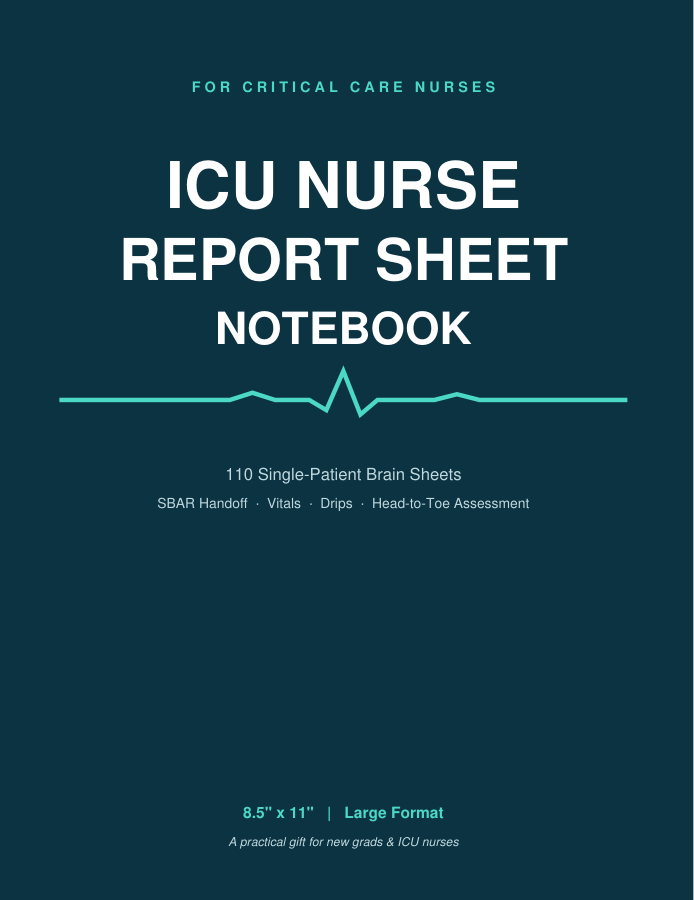
    ICU Nurse Report Sheet Notebook cover
    ICU brain sheet interior page
    ICU Nurse Report Sheet Notebook
    See the cover and what’s inside — 110 single-patient brain sheets with head-to-toe, a vitals grid, drips, and a dedicated SBAR box. 8.5×11.

    View on Amazon →

    Pocket Nurse Report Notepad

    Pocket Nurse Report Notepad

    See the design and price on Amazon →

    Sources

    AHRQ – SBAR and structured handoff communication resources

    NCBI Bookshelf – nursing handoff communication overview

    General nursing education references on shift report documentation

    Disclaimer: This article is a documentation guide for nursing students and new nurses, for general informational purposes only. It is not medical, clinical, or exam advice, and is not affiliated with or endorsed by the NCLEX® or NCSBN®. Always follow your facility’s policies and your instructors’ guidance.

  • How to Fill Out an ICU Brain Sheet

    How to Fill Out an ICU Brain Sheet

    As an Amazon Associate I earn from qualifying purchases. This is a documentation guide for nursing students and new nurses, not medical or clinical advice. Every unit does things a little differently, so your facility’s policies and your preceptor always come first.

    If you are looking at a blank ICU brain sheet with no idea where to start, that is where nearly everyone starts. A brain sheet – some units call it a report sheet, or just a nurse brain – is a one-page map of what is happening with your patient, kept where you can see it instead of in the chart. Here is what ICU nurses tend to put on theirs, box by box.

    What the sheet is actually for

    Most nurses describe it as external memory. Over twelve hours you are tracking vitals, drips, labs, lines, and a running list of small tasks, and holding all of that in your head is not a skill anyone develops – it is just a thing people stop trying to do.

    A sheet that is working lets you glance down and answer the two questions you get asked most: what is going on with this patient, and what still needs doing.

    It is worth being clear about what the sheet is not. It is not the chart, and it is not a legal record. Whatever goes on it is a working copy for your own shift, and the permanent documentation still happens where your facility says it happens. Most units also treat the sheet as protected information for as long as it exists – kept in a pocket rather than on a counter, and shredded at the end of the shift rather than carried home. Every hospital has a policy on this, and it is one of the first things worth asking about on a new unit.

    The other thing a sheet quietly does is protect you from the middle of the night. At three in the morning, after eleven hours, recall gets unreliable in ways that feel fine from the inside. Nurses who have been doing this a while tend to trust their handwriting from four hours ago more than their memory of four hours ago, and that instinct is usually right.

    The header, and why people fill it first

    The top bar is the part that gets rushed and later regretted. Date, shift, your name, room number, and code status. Allergies and admitting diagnosis usually sit here too.

    Code status tends to be placed in the first line of sight rather than tucked in with the demographics, and the reason is simple enough: it is the one thing nobody wants to be looking up in a hurry. New nurses often put it in the middle of the block, and experienced ones almost always move it to the top.

    Isolation status usually earns a place up here too. Contact, droplet, airborne, or none – written where you will see it before you walk in rather than after. The same goes for anything that changes how you approach the room at all: a patient on fall precautions, a language other than the one you speak, a hearing aid that is out.

    Weight is another entry that looks like a formality until it is not. Many ICU drips are ordered per kilogram, and a weight recorded once at the top, in kilograms, is what keeps the rest of the sheet consistent with the pumps.

    None of this takes long. The header is maybe thirty seconds of writing during report, and it is the thirty seconds people are gladdest about later.

    A head-to-toe pass, in the same order every time

    Below the header, most ICU sheets leave space for a systems review. The order matters less than the fact that it does not change:

    • Neuro – alert level, sedation, pupils, any deficits.
    • Cardiac – rhythm, blood pressure, which drips are running.
    • Respiratory – room air, nasal cannula, or vent settings.
    • GI/GU – diet or tube feeds, last bowel movement, urine output.
    • Skin and lines – wounds, dressings, and every line and drain.

    Nurses who use the same sequence every shift usually find that after a few weeks their hand goes to the next box on its own. That is the point of the consistency – it is what keeps the small items from being the ones that get skipped.

    The systems that get skipped most, when something gets skipped, are usually skin and GI. Neither tends to be the reason the patient is in the unit, so both slide down the list on a busy day. Both are also where problems build slowly and then show up all at once, which is exactly the pattern a written record catches and memory does not.

    There is a second use for this section that new nurses discover a few months in. Because you wrote the same categories at the start of the shift, you have a baseline to compare against at hour eight. “Pupils were equal at seven” is a much stronger statement than “I think they looked normal earlier,” and the only difference between the two is that one was written down.

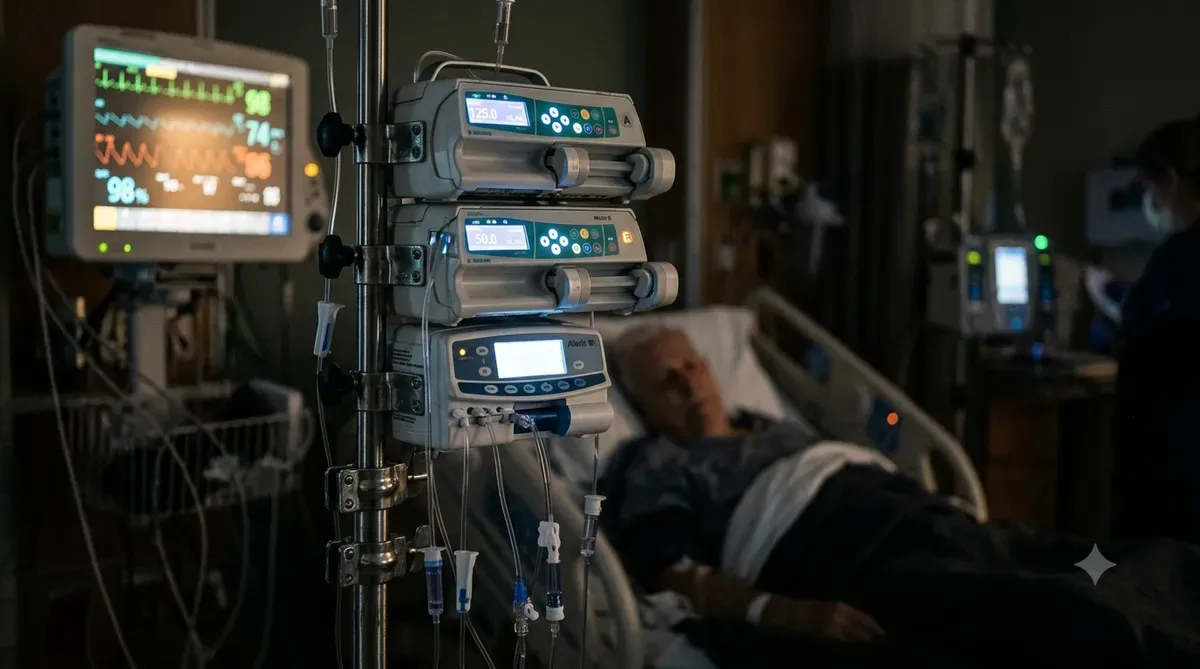
    IV infusion pumps beside a hospital bed with a patient monitor in the background

    IV pumps and monitor at the bedside

    Vitals read better as trends

    There is usually a small grid for vital signs, and the common beginner habit is to write one number and move on.

    In critical care the direction tends to carry more information than the value. A blood pressure of 95 reads one way if it was 130 an hour ago and another way if it has been climbing from 80. Sheets with room for the last two or three readings make that visible without anyone having to reconstruct it, and that shape is often the first hint that something is changing.

    The monitor already holds all of this, which makes writing it down feel redundant on a quiet shift. The reason nurses do it anyway is that the monitor shows you a moment and the sheet shows you a shape. Scrolling back through trend data while a provider waits on the phone is a slower and more error-prone way to answer the same question.

    Intake and output belongs in the same category. On its own, an hourly urine output is a number. Across a shift it is a trend, and it is often the trend that gets quoted back to you in rounds. Nurses who total it as they go rather than at the end tend to find the totals are both faster to produce and closer to correct.

    Drips and lines do better with their own space

    ICU patients often have several drips running, and this is where a cramped sheet stops helping. The layout most nurses prefer gives each drip its own line – the medication, the current rate, and any titration goal in the orders. Lines and drains get the same treatment: where each one is and when it was placed.

    Titration goals deserve their own mention. When an order allows a range, what matters is not just the current rate but what you are titrating toward – a MAP, a sedation score, a target the provider set. Sheets that record the goal beside the rate save the conversation where two people discover halfway through the shift that they were aiming at different numbers.

    Line day counts are another small entry with an outsized payoff. Writing the date a central line or a Foley went in means that when someone asks whether it is time to reassess, the answer is on the page instead of buried in the chart.

    Worth stating plainly: the sheet records what is ordered and what is running. It is not a place to work out doses, and nothing written on it replaces the orders, your facility’s protocols, or independent verification. Any dose that comes off a sheet still gets checked against the order and, where policy requires it, with a second nurse.

    The SBAR box

    The bottom of most brain sheets leaves room for SBAR – Situation, Background, Assessment, Recommendation. It is the frame used for shift report and for calling a provider.

    Nurses who jot a few words into each part through the shift tend to describe handoff the same way: by the time report comes, it is mostly already written. The alternative is reconstructing twelve hours from memory while someone waits.

    The recommendation is the part new nurses most often leave off, usually out of a sense that it is not their call. Within scope, it is. You are not diagnosing – you are saying what you think should happen next, and you are the one who has been in the room for twelve hours. “I think she needs to be seen before morning” is a clinical impression, and it is frequently the most useful sentence in the handoff.

    What tends to go wrong with a brain sheet

    A few failure patterns come up often enough to be worth naming.

    Writing too much. New nurses often try to transcribe the chart, which produces a sheet too dense to read at a glance – which was the entire point. The sheet is a map, not a copy.

    Writing too little. The opposite failure is a sheet with three words on it that made sense at eight in the morning and mean nothing at six at night.

    Not updating it. A sheet that reflects the patient as they were at the start of report is worse than no sheet, because it looks current. Crossing out and rewriting takes seconds.

    Redesigning it every week. People who keep changing their layout never build the muscle memory that makes the layout invisible. Most experienced nurses use something close to what they used a year ago.

    Where people land, eventually, is a version they stop thinking about. That is the goal – not a beautiful sheet, an automatic one.

    A rough order that works for the first hour

    There is no correct sequence, but a common one looks like this. During report, fill the header and note anything flagged as changing. Right after report, do a quick eyes-on round of every patient before touching the paperwork again. Then go back and fill in what you actually saw rather than what you were told.

    The gap between those two is where new nurses learn the most. Report is someone else’s summary; the round is yours. When they disagree, that disagreement is usually worth a second look, and it is much easier to notice when both versions are written down.

    Making it yours

    Most nurses develop shorthand within a couple of months – arrows for trends, a symbol for tasks that are pending versus done, a corner reserved for numbers to report in rounds. None of it is standardized and none of it needs to be, as long as the next person can read the parts that matter if you are pulled away.

    The one thing worth keeping legible is anything another nurse might need in a hurry: code status, allergies, drips and rates. Your personal shorthand is fine everywhere else.

    Small habits that seem to help

    Write in something you can update, because patients change and so should the sheet. Cross tasks off as they are done, so your eye lands on what is left. And do not aim for a tidy sheet – the useful one is usually the marked-up one that got someone through the shift.

    Keep the sheet in one place, ideally the same pocket every shift, so that finding it is never a step. Note the time on anything time-sensitive rather than trusting that you will remember the gap. And when the shift falls apart – and some do – the sheet is usually the first thing to abandon and the first thing worth picking back up as soon as there is a gap, because the twenty minutes you did not write are the twenty minutes you will be asked about.

    If drawing your own boxes every morning is the part you would rather skip, that is what a pre-printed report notebook is for – the header, systems, vitals grid, and SBAR box are already laid out.

    BY ELDER K · ON AMAZON
    ICU Nurse Report Sheet Notebook cover
    ICU brain sheet interior page
    ICU Nurse Report Sheet Notebook
    See the cover and what’s inside — 110 single-patient brain sheets with head-to-toe, a vitals grid, drips, and a dedicated SBAR box. 8.5×11.

    View on Amazon →

    Littmann Classic III Stethoscope

    Littmann Classic III Stethoscope

    See the design and price on Amazon →

    Sources

    • AHRQ – patient handoff and SBAR communication resources
    • NCBI Bookshelf – head-to-toe nursing assessment overview
    • General nursing education references on report-sheet documentation

    Disclaimer: This article is a documentation guide for nursing students and new nurses, for general informational purposes only. It is not medical, clinical, or exam advice, and is not affiliated with or endorsed by the NCLEX® or NCSBN®. Always follow your facility’s policies and your instructors’ guidance.