
How to Use a Pediatric Report Sheet (A Beginner’s Guide)
—
—
As an Amazon Associate I earn from qualifying purchases. This is a documentation guide for nursing students and new nurses, not medical or clinical advice. Every unit does things a little differently, so your facility’s policies and your preceptor always come first.
A pediatric report sheet looks different from every other unit’s, and there is a reason for it. On an adult floor a dose is largely a dose. In peds, almost everything traces back to one number – the child’s weight – and a sheet that does not make that number obvious is working against the nurse using it. Here is what peds nurses tend to keep on theirs, and why.
The weight goes at the top, in kilograms
Ask any peds nurse what belongs in the first line of sight and you will hear the same answer. The weight, in kilograms, written once, where anyone can see it.
The reason is not that the math is hard. It is that the most common weight-based error is not a math error at all – it is a units error, pounds sitting where kilograms belong. A 44-pound child is a 20-kilogram child, and if the 44 goes in the wrong place, everything downstream is calculated flawlessly from the wrong starting point.
Writing it once at the top, and referring back to it rather than looking it up again, is the habit most peds sheets are built around.
There is a second reason the weight sits alone at the top rather than inside the demographics block. A number that appears in one place is a number that can be corrected in one place. When the weight is copied into three sections of a sheet and the child is reweighed, two of those copies quietly become wrong, and nobody knows which one someone else read.
Most peds sheets also leave room for when the weight was taken and how – standing scale, bed scale, stated by the parent. A stated weight from a caregiver at two in the morning and a measured weight from an hour ago are not the same kind of number, and the sheet is where that distinction survives.
Two columns, not one, for medications
This is the part that most general-purpose report sheets get wrong. They give one column: dose. So the nurse does the multiplication in her head, writes the total, and the working disappears.
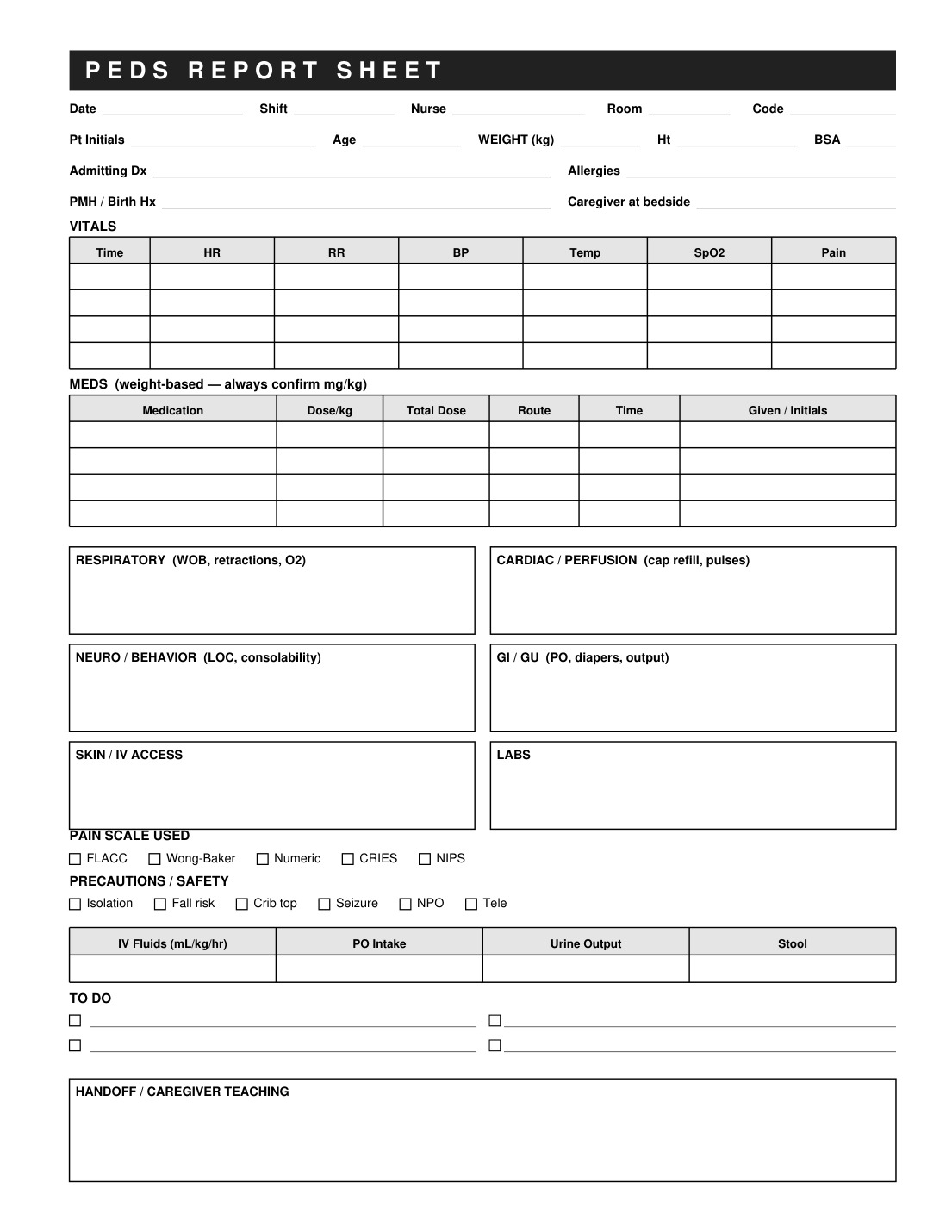
Peds sheets tend to split it in two – dose per kilogram, and total dose. It costs a few extra seconds per medication. What it buys is that the calculation sits on the page where a second person can look at it. Weight-based errors are usually caught by a second set of eyes, and a second set of eyes needs something to look at.
To be clear about what a sheet is: it records what was ordered and what was given. It is not a dosing reference, and nothing on it replaces independent verification and your facility’s protocols. Any dose that comes off a sheet still gets checked against the order, and where policy requires a second nurse, that check happens regardless of what is written.
Most peds sheets also leave room for the time each dose was given rather than only which doses are due. In a unit where several children are on weight-based antibiotics with different intervals, the times are what keep the intervals honest.
What else a peds sheet tends to carry
Beyond the weight and the medication table, a few entries show up on most pediatric report sheets and on very few adult ones.
Developmental stage, not just age. A four-year-old and a nine-year-old need different explanations before the same procedure, and a sheet that notes where this child is – whether they can tell you what hurts, whether they understand what is about to happen – saves the nurse coming on from starting over.
What comforts this child. A favorite toy, a preferred parent, whether they do better with the lights on. This is not a soft detail. A child who can be settled without medication is a better outcome than one who cannot, and the information is usually learned by one nurse and lost at shift change unless someone writes it down.
Feeding. For infants, the type, amount, and time. For older children, what they actually ate rather than what was offered. Intake in pediatrics moves faster than it does in adults, and a few missed feeds show up sooner.
Diaper or output counts. For the youngest patients this is one of the more useful trend lines available, and it is entirely dependent on someone recording each one at the time.
Fluids follow the same logic
Maintenance fluids in peds are calculated per kilogram, so a box for mL/kg/hr next to the pump rate tends to be useful for the same reason the two dose columns are. It turns the number on the pump from something someone typed into something someone can trace back.
The same logic extends to anything else the child is receiving by volume – boluses, flushes, medications given in a diluted volume. In a small patient, volumes add up in a way they do not in adults, and a running total on the sheet is easier to keep honest than one assembled from three different screens at the end of the shift.
Note which pain scale was used
Adults get a 0-10 scale and that is usually the end of it. Children get whichever scale fits their age and their ability to tell you – FLACC for the preverbal, Wong-Baker faces for young children, a numeric scale for older ones, CRIES or NIPS for neonates.
Which means a bare number is close to meaningless on a peds sheet. A 6 on FLACC and a 6 on Wong-Baker are not the same claim about the same child. Most peds sheets handle this with a row of checkboxes – tick the one you used. It takes half a second and it makes every score after it interpretable by the next nurse.
Consistency matters more than the choice itself. If the day nurse used FLACC and the night nurse switches to a numeric scale for the same child, the two scores cannot be compared, and comparison is the entire reason for scoring in the first place. Sheets that carry the scale forward from the previous shift make that continuity the default rather than something each nurse has to remember to check.
Who is at the bedside
One line that no adult sheet has and most peds sheets do: the caregiver in the room, and their relationship to the child.
This is not a courtesy note. That person is a source of history, a participant in care, and practically speaking the one whose questions you will be answering all shift. Knowing whether you are talking to a parent, a grandparent, or a guardian changes the conversation before it starts.
It also matters for the practical questions that come up at odd hours. Who can consent. Who has been told what. Whether the caregiver who was here this morning is the same one who is here now, which on a long admission is often not the case.
Some units add a line for whether an interpreter is needed and which language. It is the kind of detail that is obvious to the nurse who learned it and invisible to the one who did not.
What tends to go wrong
Recording only the total dose. The most common one, and the reason the two-column layout exists. A total with no working cannot be checked.
Pounds where kilograms belong. Rare, catastrophic, and the reason the weight sits alone at the top with its unit written out.
A pain score with no scale. Uninterpretable by anyone who was not there.
A stale weight. In a long admission, a weight from day one can be meaningfully wrong by day five.
Leaving the sheet somewhere. A peds sheet carries a child’s information. Where it goes at the end of the shift is a policy question, not a preference.
What the sheet is really doing
The argument for writing all of this down is not documentation for its own sake. Pediatric dosing is unforgiving in a way adult dosing often is not, and the defense against that is not being smarter or more careful than everyone else. It is putting the numbers somewhere a second person can see them.
If you would rather start from a layout that already has the weight line, the two dose columns, and the pain-scale row, that is what a pre-printed peds report notebook is for.

Sources
NCBI Bookshelf – weight-based medication safety in pediatrics
General pediatric nursing references on age-appropriate pain assessment scales
General nursing education references on report-sheet documentation
Disclaimer: This article is a documentation guide for nursing students and new nurses, for general informational purposes only. It is not medical, clinical, or exam advice, and is not affiliated with or endorsed by the NCLEX® or NCSBN®. Always follow your facility’s policies and your instructors’ guidance.