
How to Keep a Nursing Student Clinical Log
—
—
As an Amazon Associate I earn from qualifying purchases. This is a documentation guide for nursing students and new nurses, not medical or clinical advice. Every unit does things a little differently, so your facility’s policies and your preceptor always come first.
Clinical days move faster than they look from the outside. You are being handed information from four directions at once – the nurse, the chart, the patient, your instructor – and almost none of it repeats. Students who write things down as they go tend to describe the same benefit, and it is not about neatness. You cannot ask a good question about something you have already forgotten.
One page per clinical day
The layout most students settle into is a single page per clinical day rather than a running notebook. There is a practical reason: a page has edges. When the page is the unit, you can flip back to a specific day and find it, and you have a rough sense of whether the day is documented before you leave.
A running notebook has the opposite property. Everything blends, days lose their boundaries, and the entry you want is somewhere in the middle of forty pages of continuous writing. Students who switch to one page per day usually describe the same relief – not that they write more, but that they can find what they wrote.
The other benefit shows up at the end of a rotation. A stack of dated pages is a record of a semester. It is what you look at when your program asks for a skills tally, and it is what you look at when you are trying to remember whether you have ever actually done the thing an interviewer just asked about.
The patient basics, without the identifiers
Age, admitting diagnosis, relevant history, and the general picture. What does not go on your log is anything that identifies the patient – no names, no room numbers, no dates of birth, no medical record numbers.
This is worth being deliberate about rather than casual. Your log leaves the building with you, which means it is a different kind of document from the chart. Your school’s policy on this is the one that governs; the habit of writing “72-year-old admitted with CHF exacerbation” instead of a name is the practical version of it.
The part students underestimate is that identifiers are not only names. A room number plus a date plus a diagnosis can identify someone as surely as a name can, particularly on a small unit. The safer habit is to write only what you would need to study from – age range, diagnosis, relevant history – and nothing that would let a stranger work out who it was.
Where the log lives matters for the same reason. A notebook left in a car or a photo of a page on a phone are both places student documentation ends up, and both are worth thinking about before it happens rather than after.
Skills performed, and who supervised
Most programs want a record of skills, and most students underestimate how much they will want it later. Foley insertion, IV start, wound care, medication administration, an assessment you did on your own for the first time – with the date and the name of the nurse or instructor who supervised.
This section becomes useful in two ways. It fills out your school’s competency requirements, and when you are asked in a job interview what you have actually done, you are reading rather than guessing.
It is worth recording the ones that did not go well too. An IV attempt that failed, a catheter you started and your instructor finished, a dressing change you needed talked through. Students tend to skip these out of embarrassment, which is a shame, because a log that only contains successes is not much use for figuring out what to practice.
Some students add a small mark for how independent they were – watched, assisted, did it with supervision, did it alone. Over a semester that column turns into a fairly honest picture of progress, and it is more useful than a list that treats the first attempt and the fifteenth as the same event.
Observations, not just tasks
The other half of a clinical day is everything you saw without doing.
A code you stood at the edge of. A difficult conversation between a nurse and a family. A patient who declined something and how the nurse responded. A handoff that was unusually good, or unusually bad.
Students often leave these out because they do not feel like accomplishments. They tend to be the entries that are worth the most later. Skills get repeated until they are automatic; the moment you watched someone tell a family bad news may not come around again for months, and the details fade within days.
A line or two is enough. What happened, what you noticed, what you would want to ask someone about.
Medications given
A line per medication – what it was, the route, and the general reason this patient was on it.
The value here is not the list. It is that writing “metoprolol – beta blocker – held for HR 52” puts the drug, the class, and a piece of clinical reasoning in the same sentence, which is roughly how you will need to recall it on an exam and at the bedside. Students often find the medications they wrote down are the ones they actually retained.
A useful habit is to add the one thing you would need to check before giving it again – the parameter, the lab, the assessment. Not a full drug card, which you have on your phone, but the single item that made this medication a decision rather than a task.
What does not belong here is a dose calculation you are working out for real use. The log is a study record. Anything given to a patient goes through the order, the protocol, and whatever verification your program and facility require.
Your nursing diagnosis and care plan
Most clinical logs give room for the care planning work, and this is the section students most often rush the night before it is due.
The version that seems to help is writing a rough draft the same day, while the patient is still vivid, and cleaning it up later. A care plan reconstructed a week afterward tends to be a generic care plan. One drafted the same afternoon has the actual patient in it.
Two or three sentences on the day of clinical is usually enough to hold it: what the actual problem seemed to be, what you would want to happen, and what you saw that supports it. The formatting your program wants can be applied later. What cannot be recovered later is the detail that made this patient specific rather than a textbook example.
Questions for your instructor
Leave a box for this and use it during the day.
You will be told to ask if you have questions, and then your mind will go blank the moment someone looks at you. That is nearly universal and it is not a sign of anything. Writing the question down when it occurs to you – even half-formed, even if you answer it yourself an hour later – is the difference between asking three real questions in a clinical day and asking none.
What you learned
The reflection box is the one students skip most and later wish they had not.
Two or three lines is enough. Something you saw for the first time. Something you did badly and would do differently. Something a nurse said that landed. Nursing school goes by in a blur, and this is the part of the log you will still have something to say about in two years.
It is also, practically, where interview answers come from. “Tell me about a time something did not go as planned” is a question almost every new graduate gets, and the students who answer it well are usually the ones who wrote something down that afternoon rather than trying to summon it under pressure.
What tends to go wrong
Writing it three days later. The most common one. What comes back is the shape of the day, not the details worth keeping.
Recording only what went well. Understandable, and it removes the most useful material.
Including identifiers. Names, room numbers, dates of birth. Easy to do casually and hard to undo.
Copying the chart. The log is your thinking about the day, not a duplicate of the record.
Skipping the reflection box. The section students most reliably skip and most reliably regret.
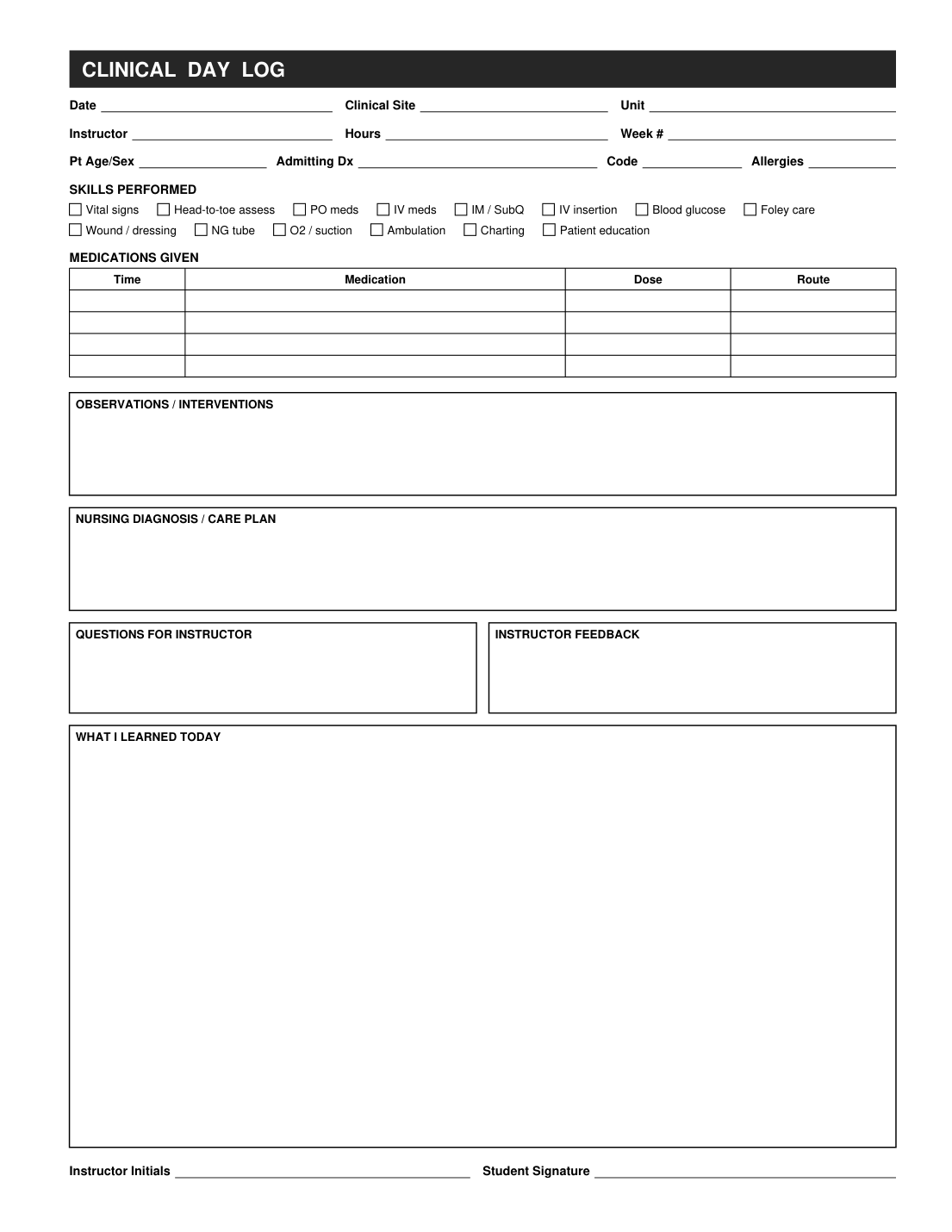
If starting from a layout that already has the skills section, the medication lines, the care plan space, and the reflection box sounds easier than reformatting a notebook every week, that is what a pre-printed clinical log is for.
Sources
NCBI Bookshelf – clinical reflection and reflective practice in nursing education
General nursing education references on clinical journaling and competency records
HHS – general guidance on protecting patient information in student coursework
Disclaimer: This article is a documentation guide for nursing students and new nurses, for general informational purposes only. It is not medical, clinical, or exam advice, and is not affiliated with or endorsed by the NCLEX® or NCSBN®. Always follow your facility’s policies and your instructors’ guidance.