SBAR Handoff for New Nurses (A Beginner’s Guide)
—
—
As an Amazon Associate I earn from qualifying purchases. This is a documentation guide for nursing students and new nurses, not medical or clinical advice. Every unit does things a little differently, so your facility’s policies and your preceptor always come first.
Giving report is the part of nursing that makes new nurses most self-conscious, and it is one of the few skills nobody really practices before doing it in front of an audience. SBAR is the frame most units use to keep it organized – Situation, Background, Assessment, Recommendation. Here is what each letter tends to hold, and why the order matters more than it looks.
Why a frame helps at all
Without a structure, report tends to come out in the order things happened to you rather than the order the listener needs. The receiving nurse does not need your morning; they need to know what they are walking into.
SBAR fixes the order. That is most of what it does, and it is enough.
It came out of aviation and the military before it came into healthcare, and the reason it transferred is that both fields have the same problem: someone with information has to hand it to someone who has none, quickly, often under pressure, and often across a difference in seniority that makes people hedge. A shared structure means the listener knows what is coming next, which is a surprisingly large part of being understood.
It is also worth saying what SBAR is not. It is not a script you have to recite word for word, and it is not a substitute for your facility’s handoff policy or whatever tool your unit uses. It is a way of ordering what you were going to say anyway.
S – Situation
One or two sentences: who this is and why you are talking about them right now.
Room, name, age, and the reason for admission, then the reason for this conversation. For shift report that is usually the state of the patient. For a provider call it is the thing that prompted the call, said in the first sentence rather than the fifth.
New nurses often start too far back. The listener has not met this patient yet, but they also cannot hold a history before they know what the point is.
A useful test: could the person you are calling write down why you called after your first two sentences? If not, the situation has not landed yet.
For a call in the middle of the night, most experienced nurses front-load even harder. Name, room, and the problem in one breath, before anything else. The provider you woke up is orienting from zero, and the fastest way to help them is to say the thing you are worried about first.
B – Background
The context that makes the situation make sense. Admitting diagnosis, relevant history, allergies, code status, what has been done so far this admission.
The judgment call here is what counts as relevant, and it takes a while to develop. The rough test most nurses use: would this change what the listener does next? A cardiac history matters for a patient with new chest pain. A childhood appendectomy usually does not.
Background is also where the length of a handoff is usually decided, and where the difference between a shift report and a provider call is largest. A provider calling back at two in the morning wants three or four items. A nurse taking your patients for the next twelve hours wants considerably more, because they will be living with the details.
New nurses tend to err toward completeness, and that instinct is not wrong at the start – it is easier to learn to trim than to learn to notice what you left out. Most people find the filter develops on its own within a few months, largely by watching which parts of their report people wrote down.
A – Assessment
What you are seeing, and what you make of it.
Vitals with trends rather than single values, your relevant findings, and pain. Then, and this is the part that feels presumptuous at first, your read on it. “I think she is more short of breath than this morning.” “Something seems off, but I cannot point to one number.”
New nurses often leave this out, on the grounds that it is not their place to interpret. It is – within scope. You are not diagnosing. You are reporting a clinical impression, and it is often the most valuable sentence in the call, because you are the one who has been in the room.
The phrasing that helps most people get past the hesitation is simple ownership: “what I am seeing is,” or “what worries me is.” Both are honest about the fact that this is your read, and neither claims more than that.
It is also fine to say you cannot name it. “Nothing on the monitor has changed but she looks different to me” is a legitimate assessment statement, and experienced clinicians tend to take it seriously, because that particular sentence has a good track record.
R – Recommendation
What you are asking for, or what you think should happen next.
For a provider call: “Could you come see her,” or “would you like an ABG.” For shift report: what is still pending, what is scheduled, and what to watch for.
Ending without this is the most common way an otherwise good report falls flat. The listener has all the information and no idea what you want done with it.
The other half of the recommendation is closing the loop. If an order comes back verbally, most units expect it read back and confirmed, and that read-back is part of the handoff rather than an add-on. If nothing is ordered and you are still uneasy, saying when you will call again – or asking what would change the plan – keeps the conversation from ending in an ambiguity you have to sit with for four hours.
When it does not go smoothly
Not every call goes well, and new nurses tend to assume that means they did it wrong.
Sometimes the person on the other end is short with you. Sometimes they ask a question you cannot answer, which is worth writing down and looking up rather than guessing at. Sometimes you get a plan you do not agree with.
Every facility has a chain of communication for that last one, and knowing what yours is – before you need it – is part of being ready to make these calls at all. Escalating is not a conflict; it is the process working. Your charge nurse is usually the first step and is almost always glad to be asked early rather than late.
If a call goes badly, the useful move afterward is to write down what you would say differently. Most people’s reports improve in specific, fixable ways rather than gradually.
Shift report is a different animal
Provider calls are narrow and deep – one problem, one decision. Shift report is wide and shallow, and it has a different failure mode: running out of attention before running out of patients.
Most nurses handle this by putting the same things in the same order every time and keeping the first pass short. Room, name, age, why they are here, code status, and the one thing that matters most for this patient. The details follow for the patients who need them.
The other thing worth doing is naming what is unfinished plainly rather than burying it. “The two o’clock antibiotic did not get hung, it is still due” is a better sentence than a hopeful summary. Nobody minds being told; people mind finding out.
Where the report sheet comes in
The nurses who give calm report are usually not the ones with better recall. They are the ones whose sheet already had the pieces.
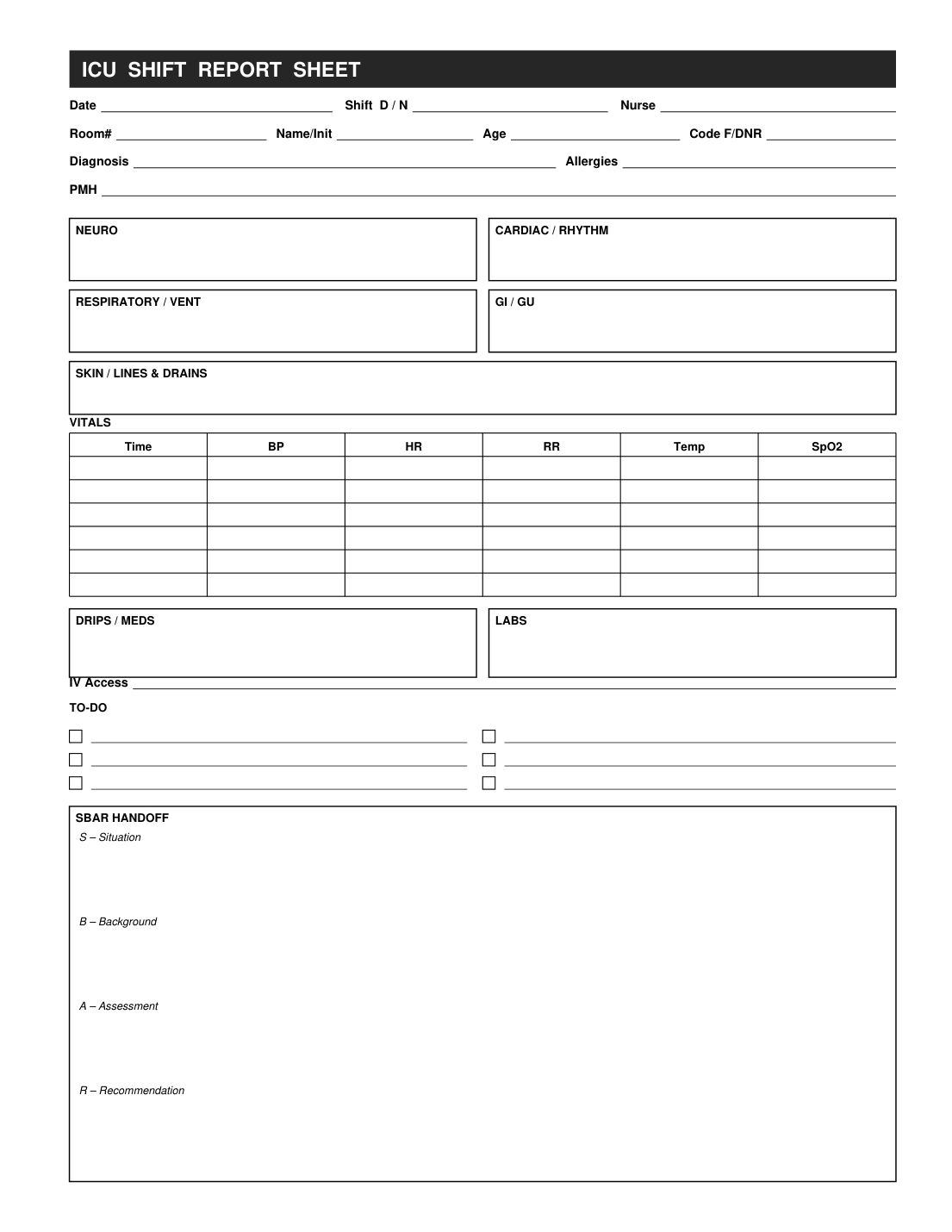
A sheet kept current through the shift tends to map onto SBAR almost directly. The header block is your situation. History, allergies, and code status are your background. The vitals grid and your notes are your assessment. The to-do column and what is pending is your recommendation. Many report sheets include a dedicated SBAR box for exactly this reason – so that a few words jotted at the time become report later, rather than something you rebuild from memory at seven in the morning.
It gets less uncomfortable
Early on, report feels like a test. Later it feels like a conversation between two people who both want the same thing.
What shortens that gap for most people is having the same structure every time and writing as they go. Neither is a talent. Both are habits.
If it helps, the things new nurses are self-conscious about are rarely the things the listener notices. Speaking slowly is fine. Pausing to check your sheet is fine, and reads as thorough rather than unprepared. Saying “I do not know, let me find out” is fine and is a much better answer than a guess.
What people do notice is a report that arrives in a random order, and that is the one part a structure fixes for free.
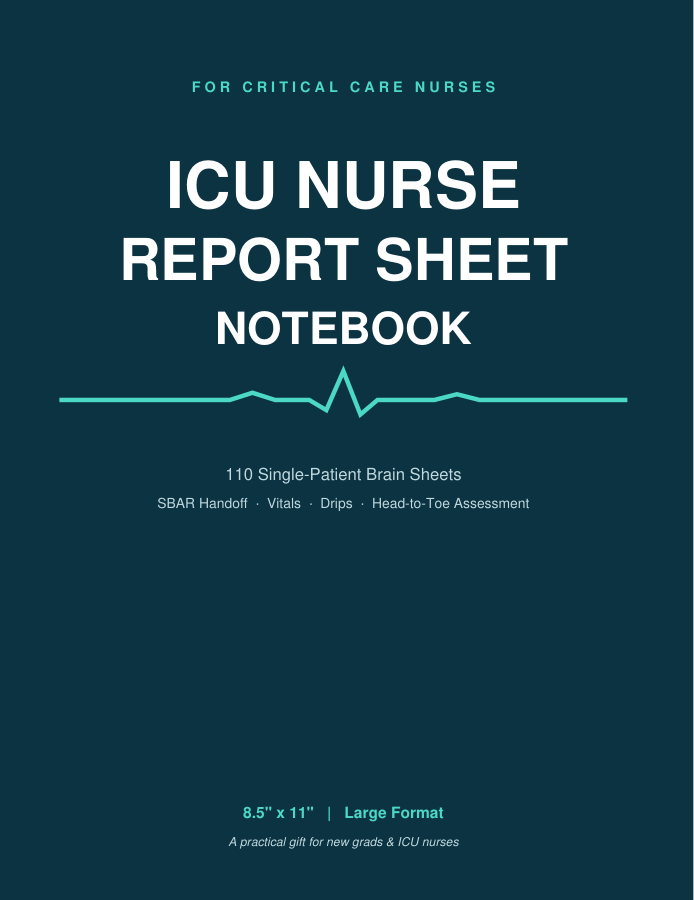
If starting from a sheet that already has an SBAR box sounds easier than remembering to leave room for one, that is what a pre-printed report notebook is for.

Sources
AHRQ – SBAR and structured handoff communication resources
NCBI Bookshelf – nursing handoff communication overview
General nursing education references on shift report documentation
Disclaimer: This article is a documentation guide for nursing students and new nurses, for general informational purposes only. It is not medical, clinical, or exam advice, and is not affiliated with or endorsed by the NCLEX® or NCSBN®. Always follow your facility’s policies and your instructors’ guidance.